


Reason to trust
How Our News is Made
Strict editorial policy that focuses on accuracy, relevance, and impartiality
Ad discliamer
Morbi pretium leo et nisl aliquam mollis. Quisque arcu lorem, ultricies quis pellentesque nec, ullamcorper eu odio.
LiquidChain ($LIQUID) consolidates multi-chain operations through unified infrastructure. One wallet accesses Bitcoin, Ethereum, and Solana liquidity. Single gas token covers all transactions. Cross-chain execution happens in atomic operations.
The crypto presale approaches $50,000 with 3.5 million tokens staked at $0.01225 per token. Mainnet deployment activates full cross-chain functionality.
Q3 2026 centralized exchange listings follow. This altcoin to buy removes workflow friction for multi-chain operations.
Managing Three Separate Wallets Slow Down Multi-Chain Trading
Multi-chain traders maintain separate wallet infrastructure for each ecosystem. A Bitcoin wallet holds BTC positions. An Ethereum wallet manages ETH and ERC-20 tokens. A Solana wallet stores SOL and SPL tokens.
Each wallet requires separate seed phrase management. Losing one seed phrase means losing that portion of the portfolio. Security considerations multiply across three different backup systems.
Switching between wallets breaks trading flow. A trader spots an opportunity on Solana but currently operates in their Ethereum wallet. Opening the Solana wallet, finding the right interface, and executing takes valuable seconds.

Gas token management creates additional overhead. Running out of ETH gas mid-trade stops execution. Running out of SOL means transactions fail. Running out of BTC means transfers stall.
Multi-chain traders constantly juggle gas balances across three networks. Buying gas on one chain to fund operations on another requires exchange trips. Time spent managing operational details reduces time spent analyzing markets.
Unified Liquidity Pools Remove Bridge Delays
Current cross-chain trading requires bridge protocols. Moving Bitcoin to Ethereum takes multiple block confirmations. Ethereum to Solana transfers wait for finality on both sides.
Bridge delays kill time-sensitive opportunities. A trader spots arbitrage between Ethereum and Solana. By the time the bridge completes, the price gap closes. Profit opportunity disappears waiting for transaction finality.
Multi-step bridge processes introduce failure points. Transactions stuck in bridge contracts create anxiety. Funds sit in limbo between chains waiting for validator confirmations.
LiquidChain’s unified liquidity pools remove bridge waiting periods. Assets from Bitcoin, Ethereum, and Solana exist in combined pools. Cross-chain trades execute in single transactions.
Atomic settlement means trades complete or fail entirely. No partial execution, no stuck funds. Multi-chain traders get immediate confirmation across all three ecosystems simultaneously.
The high-performance VM processes trades with Solana-class speed. Cross-chain proofs verify Bitcoin UTXOs, Ethereum accounts, and Solana states in real time. No waiting for multiple confirmation periods across separate networks.
Deploy-Once Architecture Gives Traders Access to dApps Across All Three Chains
Current blockchain development fragments applications across separate deployments. A DeFi protocol built for Ethereum doesn’t exist on Solana. Solana applications don’t run on Bitcoin.
Multi-chain traders face limited application access on each individual chain. Ethereum offers deep DeFi but lacks certain high-speed applications. Solana hosts fast protocols but misses Ethereum’s established projects.
Developers building for multiple chains maintain separate codebases. A prediction market on Ethereum requires completely different code for Solana. Teams choose one ecosystem and ignore others.
LiquidChain’s deploy-once architecture changes this dynamic. Developers build applications once and deploy across Bitcoin, Ethereum, and Solana simultaneously.
Multi-chain traders gain access to expanded application ecosystems. A dApp built on LiquidChain reaches users across all three chains. Prediction markets, memecoins, and DeFi protocols deploy to unified infrastructure.
For traders, this means more opportunities without switching ecosystems. Applications previously locked to one chain become accessible from any chain. The deploy-once model expands available strategies for multi-chain operators.
$LIQUID Token Pays Network Fees for BTC, ETH, and SOL Transactions
Multi-chain traders currently manage three separate gas currencies. Ethereum transactions require ETH gas. Solana transactions need SOL. Bitcoin transfers consume BTC in fees.
Running low on any single gas token stops operations on that chain. A trader holding substantial USDC on Ethereum can’t move it without ETH for gas. SOL positions become immobile without SOL gas reserves.
LiquidChain simplifies this through single-token fee payment. $LIQUID covers network fees for transactions across Bitcoin, Ethereum, and Solana. Multi-chain traders hold one gas token instead of three.
Operations become streamlined. No checking ETH gas before Ethereum trades. No verifying SOL balance before Solana swaps. $LIQUID handles fees across all chains.
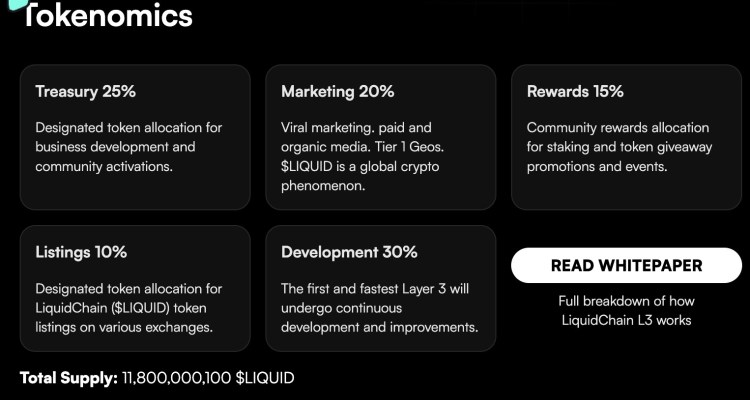
The 11.8 billion token supply includes 30% for development, 25% for treasury, 20% for marketing. Rewards claim 15%, listings get 10%. Token utility grows as transaction volume increases across chains.
Presale at $0.01225 Offers Entry Before Cross-Chain Functionality Goes Live
The LiquidChain crypto presale approaches $50,000 in total commitments. Multi-chain traders positioning early recognize infrastructure value before retail markets.
Staked tokens reached 3.5 million from participants locking positions. Staking rewards exceed 16,000% APY during presale.
Entry price sits at $0.01225 per token. Traders building positions at this level get hold of the value before mainnet deployment. Each presale milestone brings the project closer to full functionality.
Mainnet launch activates unified liquidity pools and cross-chain execution. Multi-chain traders gain operational consolidation they currently lack. Q3 2026 centralized exchange listings bring institutional liquidity tiers.
Timing matters for infrastructure plays. The operational benefits become available at mainnet. Traders positioning during presale secures allocations before cross-chain functionality goes live. All these features also make it one of the crypto presales to buy.
Discover the future of cross-chain liquidity with LiquidChain:
Presale: https://liquidchain.com/
Social: https://x.com/getliquidchain


